Short answer: a weight-activated shroud feeder from Brome or Woodlink is built to close under a squirrel’s weight, and in the owner reports we read it mostly keeps adult gray squirrels out when it’s hung with real clearance — nothing on this list stops every squirrel in every yard, and every maker we checked says so in their own disclaimers. If you already fight raccoons or bears, the hardware matters less than the pole and baffle it’s mounted on. If cardinals matter to you, look for an adjustable weight setting, not just a squirrel-resistant label. Everything below is compared on manufacturer specs and owner reports gathered directly from maker and retailer product pages — we haven’t tested any of these, and where a listing didn’t independently load for us, we left the product out rather than guess.
At a glance
| Pick | Mechanism | Capacity | Mount | Cardinal headroom | Band | Best for |
|---|---|---|---|---|---|---|
| Brome Squirrel Buster Plus | Weight-activated shroud, adjustable | 5.1 lb | Hanging | Yes, adjustable | $75–150 | High-traffic yards, low-maintenance refills |
| Brome Squirrel Buster Standard | Weight-activated shroud, adjustable | 1.3 lb | Hanging | Yes, adjustable | $25–75 | Budget entry into the Brome line |
| Brome Squirrel Buster Classic | Weight-activated shroud, fixed | 2.4 lb | Hanging | Not adjustable | $75–150 | Simple, no-fuss operation |
| Woodlink Absolute II | Weight-activated counterbalance perch | 12 lb | Hanging or pole | Yes, on light setting | $75–150 | Big yards, infrequent refills |
| Perky-Pet Squirrel-Be-Gone Max | Weight-activated Seed Shield + Flexports | 4 lb | Hanging | Yes, ladder perch fits both | $25–75 | Mixed flocks, mess control |
| Perky-Pet Squirrel Slammer | Weight-activated slam-shut ports | 3.5 lb | Hanging | Adjustable weight setting | $25–75 | Budget-first buyers, milder squirrel pressure |
| Arundale Sky Cafe | Dome-and-baffle geometric exclusion | ~several days’ seed | Hanging or pole | Yes, open tray | $75–150 | Cardinal-heavy yards, aesthetics |
| Roamwild Mega PestOff | Dual spring-loaded baffles | 8 lb | Hanging | Disputed — see below | $75–150 | Infrequent refills, if it suits your birds |
Specs are manufacturer-rated, gathered from maker and retailer product pages in September 2026, each checked live at the source when we built this page — not independently bench-tested. Price bands, never prices: they move weekly; the bands don’t.
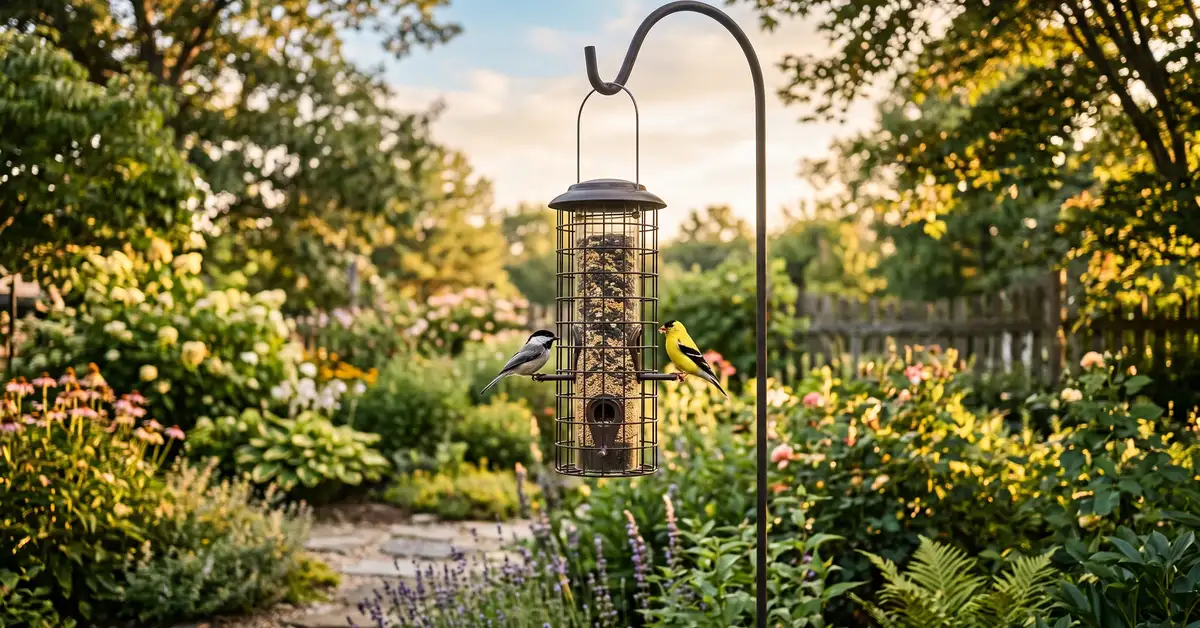
“Squirrel-proof” is a marketing word, not an engineering guarantee — every maker below admits it in their own fine print. What varies is which animals a design keeps out (Brome’s own disclaimer lists juvenile red, Douglas and flying squirrels and chipmunks among the animals its Squirrel Buster Plus won’t deter; the owner reports we read describe adult gray squirrels as the ones these mechanisms mostly keep out) and whether it survives a raccoon that just wants the pole to stop moving. Read the honest trade-off under each pick before you buy.
Transparency first: This guide contains affiliate links. If we’re enrolled in an affiliate program, we may earn a commission at no extra cost to you — it never affects how we research or rank. Read our full affiliate disclosure policy.
Brome Squirrel Buster Plus
Choose this if: you host heavy bird traffic and want the largest capacity in Brome’s line without giving up cardinal access — the adjustable Cardinal Ring is built specifically for that trade-off.
The Plus is Brome’s flagship: a 5.1 lb seed capacity behind six feeding ports, with a weight-adjustable shroud that drops over the ports the instant a squirrel’s weight lands on it, while staying up for lighter birds. It’s fully tool-free to disassemble for cleaning, and the manufacturer’s own disclaimer is refreshingly specific: it will not deter grackles, starlings, juvenile red, Douglas or flying squirrels, chipmunks, possums, bears, deer or raccoons. That’s not a flaw we found — it’s what Brome tells you upfront, and it’s the honest ceiling for every weight-activated design on this list, not just this one.
Brome Squirrel Buster Standard
Choose this if: you want the Brome shroud mechanism at the lowest price and smallest footprint in the line — a compact feeder for moderate traffic or limited space.
The Standard holds 1.3 lb of seed across four ports, with the same weight-adjustable shroud as the Plus, sized down. Brome specifies 18 inches of clearance around the feeder so a squirrel can’t reach across from a nearby ledge without triggering the closing mechanism — that clearance number matters more than the model you buy, and it applies to every Brome feeder on this list.
Brome Squirrel Buster Classic
Choose this if: you’d rather not fiddle with a weight adjustment at all — the Classic’s shroud is fixed, not tunable, and Brome markets that as a simplicity feature rather than a limitation.
At 32 inches tall with a 2.4 lb capacity and four ports, the Classic is the tallest model in Brome’s range. The trade-off for going non-adjustable is straightforward: you can’t dial the threshold down to exclude larger birds the way you can on the Standard or Plus, so if grackles or jays are dominating your feeder, one of the adjustable models suits that problem better.
Woodlink Absolute II Squirrel-Resistant Feeder (12 lb)
Choose this if: refill frequency is your real problem — 12 lb of capacity across two counterbalance perches means weeks between fills rather than days.
Woodlink’s Absolute II uses counterbalance perches adjustable to light, medium or heavy: at the light setting, the maker specifically lists cardinals, American goldfinches, downy woodpeckers, house sparrows, juncos, pine siskins and purple finches as birds under the roughly two-ounce threshold that keeps the perch open. A metal shield drops over the seed tray the instant a heavier animal steps on, and the steel body is rated to handle repeated weather and animal pressure across seasons — current owner feedback we reviewed runs strongly positive on durability, with the most common complaint being a slow start while the local birds learn the feeder.
Perky-Pet Squirrel-Be-Gone Max with Flexports (4 lb)
Choose this if: you want a ladder-style perch that fits both small and large birds at a mid-range price, and you’re prepared to stay on top of one known wear part.
The Squirrel-Be-Gone Max combines a weight-activated Seed Shield with a Sure-Lock cap that stops squirrels lifting the lid, across four Flexport feeding stations rated to cut spillage. The honest trade-off, drawn straight from the maker’s own current customer reviews: the flexible port gaskets are a genuine long-term wear point, with multiple owners reporting them degrading within one to two years of regular use and no replacement parts sold separately. Perky-Pet’s own support responses confirm replacement Flexports aren’t available and point owners to the one-year warranty instead — budget for that ceiling rather than assuming indefinite service life.
Perky-Pet Squirrel Slammer (3.5 lb)
Choose this if: you want the lowest-cost entry into weight-activated squirrel resistance and your local squirrel pressure is moderate rather than severe.
Three feeding ports slam shut under a squirrel’s weight, with an adjustable sensitivity knob and a small baffle over the ports for extra cover. We’ll be direct about this one: it’s the most polarizing feeder on this list. Owner reports we reviewed on the maker’s own site are split between people who say it works exactly as advertised once installed with proper clearance, and at least one detailed report of red squirrels feeding through the mechanism within a week. Perky-Pet’s own reply to that review recommends 8–10 feet of separation from launch points, which lines up with the placement-physics section below — if you buy this one, treat the clearance distance as mandatory, not optional.
Arundale Sky Cafe
Choose this if: cardinals are the whole point — the Sky Cafe’s open circular tray under a 17-inch dome is the one design on this list built around a bird that hesitates to land on narrow perches.
Instead of a weight-triggered mechanism, the Sky Cafe relies on geometry: a smooth, wide dome that squirrels slide off when they try to climb down the support chain, protecting an open tray underneath that suits cardinals, chickadees, titmice and woodpeckers equally well. The maker backs it with a lifetime warranty against squirrel damage specifically. The trade-off owners report most often isn’t squirrels at all — it’s that a determined raccoon can still damage the hanging chain, so budget for a heavier-gauge chain than the one it ships with if raccoons visit your yard.
Roamwild Mega PestOff (8 lb)
Choose this if: you want the largest capacity on this list at a mid-range price and you’re feeding smaller songbirds rather than jays or woodpeckers.
Dual spring-loaded ports and an anti-squirrel ring guard an 8 lb reservoir, with the maker rating clearance at 18 inches from any vertical surface, consistent with every other feeder here. We’re flagging this one honestly rather than smoothing it over: current owner reviews on the maker’s own site are split on the large-bird exclusion claim specifically — one recent review reports jays, crows and woodpeckers feeding from it despite the marketing copy, and a second reports the opposite problem, songbirds refusing to use it at all. If large-bird exclusion or guaranteed songbird uptake is your reason for buying, treat those specific claims as unconfirmed rather than settled.
What we left out, and why
| Product | Why it’s not here |
|---|---|
| Kingsyard caged-tube feeder | Research lead only — we couldn’t independently load a current manufacturer or retailer product page to verify it when we compiled this guide. Our verified-or-omit rule says omit rather than publish on an unconfirmed listing. |
| Heritage Farms Original Absolute (single-sided) and Absolute II dual-sided | Same issue: the listings we had for these specific SKUs didn’t independently load when we checked in September 2026. The Woodlink Absolute II above covers the same weight-activated-counterbalance, big-capacity role with a listing we could verify live. |
| Droll Yankees Yankee Flipper (motorized spinning perch) | This is a real product — but the manufacturer’s own storefront listed it as out of stock when we checked in September 2026. We don’t recommend a specific purchase we couldn’t verify as buyable; check back, or look for the mechanism under Droll Yankees’ current lineup if motorized deterrence interests you. |
| Any feeder marketed as an absolute “squirrel-proof” guarantee with no manufacturer disclaimer at all | Category-level exclusion: every feeder we could verify carries an honest limitations disclaimer from its own maker. A listing with zero acknowledged limitations was a reason for more scrutiny, not less. |
Placement beats hardware — the 5-7-9 rule
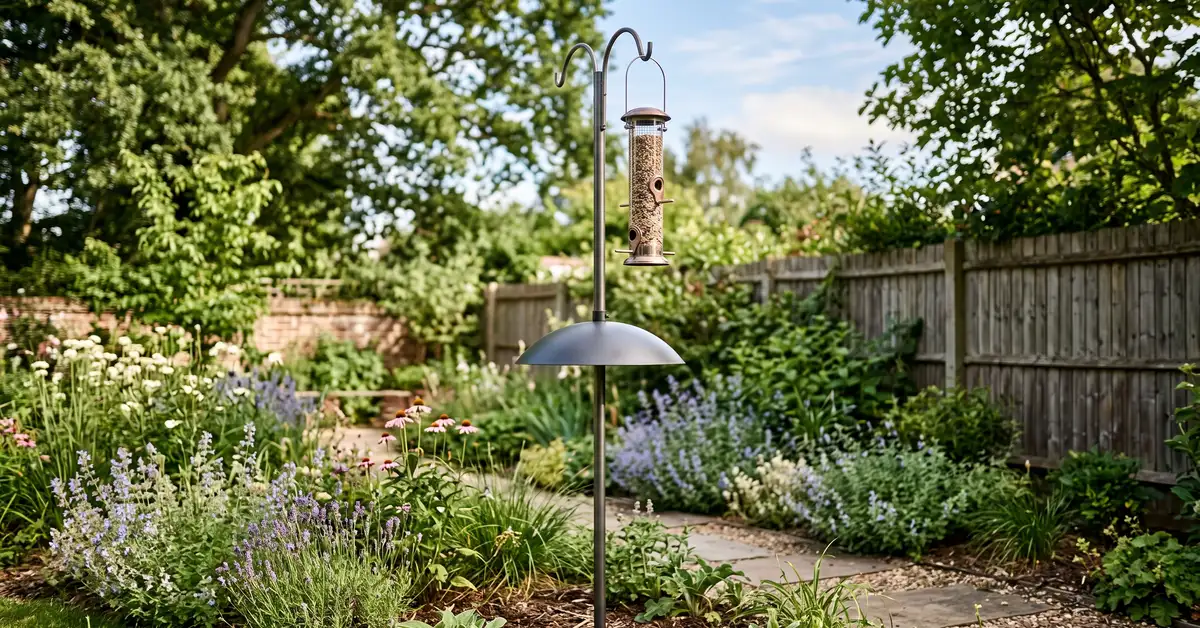
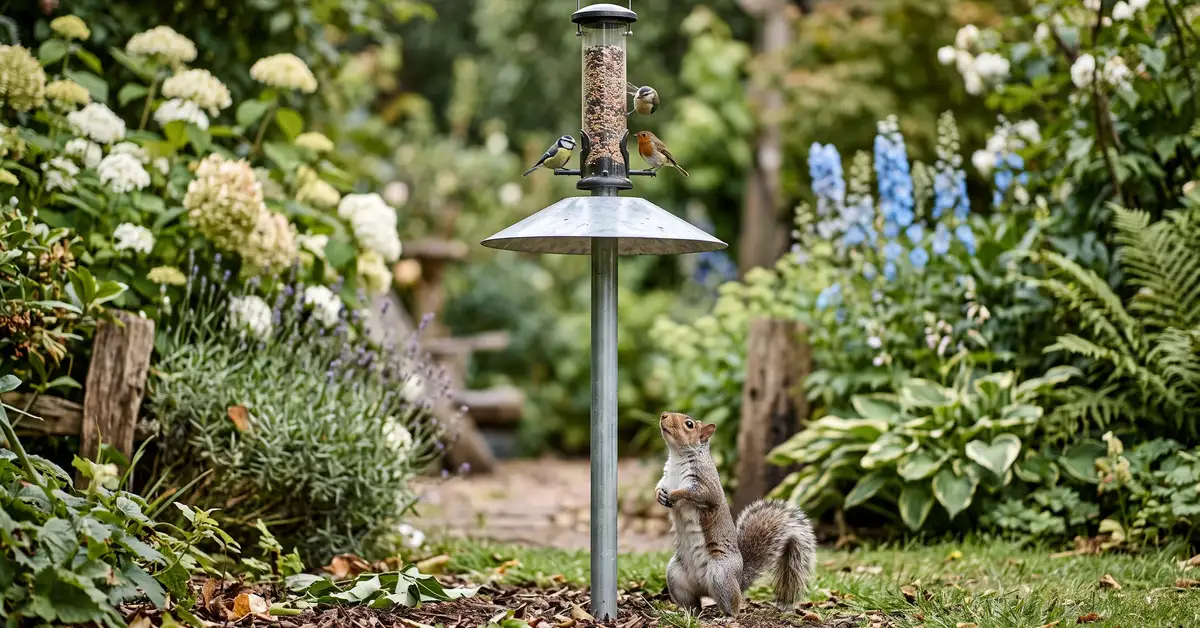
Every mechanism above shares the same failure mode: a squirrel that can reach the feeder without climbing onto it never triggers the weight-activated closure at all. The Audubon Shop’s placement guidance is the clearest version of the fix — feeders belong 5 feet off the ground, 7 feet from the nearest bush or fence, and 9 feet below any overhanging branch, because a squirrel can jump roughly 4 feet vertically from a standing start. Meet those three distances and a squirrel has to climb the feeder itself to get at the seed, which is exactly the behavior every mechanism above is built to catch (Audubon Shop).
A baffle mounted on the pole, at least 4.5–5 feet up, does the same job as distance when a tree or fence is closer than you’d like. Raccoons are a separate problem from squirrels: a heavier animal can still bend a support or break a hanging chain even when the feeder mechanism itself works perfectly, so in raccoon country the pole and chain gauge matter as much as the feeder you choose.
Window safety and hygiene
Squirrel-proofing and bird safety pull in different directions on one point: placement that’s good for squirrel exclusion can be bad for window strikes if it’s not also placement-aware for glass. The Cornell Lab of Ornithology’s guidance is to keep feeders either within about 3 feet of a window, so birds can’t build up dangerous speed before a possible strike, or more than 30 feet away, so the window isn’t perceived as a flight path at all — the mid-distance zone in between is the one to avoid (National Audubon Society).
On hygiene: clean any feeder on a schedule, not just when it looks dirty, and if you see a sick bird at your feeder, Cornell Lab’s Project FeederWatch recommends removing the feeders it is using for a couple of weeks — feeders concentrate birds in a way that can spread disease. Follow current local wildlife-agency guidance if there’s a reported outbreak in your area; we’re not veterinarians and we’re not claiming otherwise.
We haven’t tested any of these products ourselves — specs above come from manufacturer and retailer documentation checked live when we compiled this guide, and the placement and safety guidance comes from Audubon and Cornell Lab research (our winter feeding guide and heated bath guide cover the same placement principles for other gear).
Squirrel-proof feeder questions, short answers
How we picked: manufacturer and retailer documentation for every spec, each product’s current listing and price band checked live at the source when we compiled this guide (September 2026), plus Audubon Shop and Cornell Lab of Ornithology guidance on placement and hygiene. No testing of any kind is claimed, and we omitted rather than guessed at any product whose current listing we couldn’t independently verify. Details in How we pick.