Short answer: a suction-mounted acrylic feeder from Nature Anywhere or Nature Gear is the easiest way into window feeding — cheap, tool-free, and close enough to the glass to sidestep the collision risk that hanging feeders further out don’t have to think about. If you want a heavier-duty setup that survives real winters, an in-window box feeder from Coveside trades suction cups for a wooden frame that wedges into the window opening itself. The one thing every window feeder gets right by default that a pole-mounted feeder has to be placed deliberately to match: it sits inside the collision-safe zone. Everything below is compared on manufacturer specs and current retailer listings — we haven’t tested any of these, and where a listing didn’t independently verify for us, we left the product out rather than guess.
Why window feeders are the safer default, not just the closer one
Most bird-feeder placement advice is built around keeping distance from glass. Window feeders flip that: they’re mounted directly on the window, and that turns out to be the right answer rather than a compromise. The Cornell Lab of Ornithology’s guidance is that a feeder within about 3 feet of a window keeps a bird from building up dangerous speed before a possible strike, while a feeder in the middle distance — roughly 3 to 30 feet out — sits in the highest-risk zone, because the bird has room to accelerate but the window still reads as open space or a reflection (Cornell Lab of Ornithology). The National Audubon Society’s winter feeding guidance repeats the same 3-foot/30-foot framing and specifically calls out suction-mounted window feeders as a comparatively safe option, especially paired with a decal or film on the glass itself (National Audubon Society). A magazine piece quoting Cornell’s Christine Sheppard adds a useful nuance: collision risk looks highest in that 16-to-33-foot middle zone, and even a 3-foot placement doesn’t eliminate strikes entirely, it just cuts the impact speed (Southern Living). Practically, that means a window feeder is doing something right just by existing where it is — a decal or strip of film on the glass around it is still worth adding, since a bird can strike a window it doesn’t see even from 3 feet away.
At a glance
| Pick | Mount | Capacity | Seed types | Mirror/viewing | Suction-rated weight | Band | Best for |
|---|---|---|---|---|---|---|---|
| Nature Anywhere Transparent Acrylic | Suction cup | Several cups (tray, not itemized) | Mixed seed | No — two-way clear | Not stated by maker | $25–75 | First-time window feeding, budget entry |
| Nature Anywhere Clear Plastic (Gift Box) | Suction cup | Similar to standard acrylic | Mixed seed | No — two-way clear | Not stated by maker | $25–75 | Gifting, same mechanism as the standard model |
| Nature Anywhere Window Hummingbird Feeder | Suction cup | Leak-proof reservoir (oz not itemized) | Nectar | No — two-way clear | Not stated by maker | $25–75 | Hummingbird-only setups |
| Nature Gear Sliding Tray | Suction cup | Not itemized in ounces | Mixed seed | No — two-way clear | Strong suction cups, weight not stated | $25–75 | Easy-clean refills without dismounting |
| Nature Gear Column-Style | Suction cup | Taller column, volume not itemized | Mixed seed | No — two-way clear | Strong suction cups, weight not stated | $25–75 | Vertical feeding, multiple birds at once |
| Nature’s Hangout Outside Window Feeder | Suction cup | Not itemized | Mixed seed | Not specified | Not stated by maker | $25–75 | Budget alternative to the Nature Anywhere line |
| Songbird Essentials Clear View Deluxe (mirrored film) | Suction cup (2 large cups) | 4 cups | Mixed seed | Yes — includes 14″x8″ one-way film | Not stated in ounces/lb, “large suction cups” | $25–75 | Watching birds up close without being seen |
| Songbird Essentials SE539 Suet Window Feeder | Suction cup (2 heavy-duty cups) | 1 suet cake | Suet only | No — two-way clear, tail-prop for woodpeckers | Not stated by maker | <$25 | Woodpeckers and clinging feeders at a window |
| Coveside In-House Breadbox (2-way mirror) | In-window box, wedges into 24–36″ opening | Up to 2 quarts | Seed, suet or fruit | Yes — 2-way mirror | N/A — not suction-mounted | $75–150 | Heavy-traffic feeding, no glass-mounting risk |
| Coveside Panoramic In-House (mirrored back) | In-window box, fits 26–36″ windows | Not itemized, panoramic tray | Seed, suet or fruit | Yes — one-way mirrored panel | N/A — not suction-mounted | $75–150 | Wide viewing area, undisturbed close-up watching |
| Woodlink WL13207 Window Glass Hanger | Suction cup accessory, hangs a separate feeder | N/A — hanger only | Depends on feeder hung from it | N/A | Holds up to 4 lb | <$25 | Converting an existing small or hummingbird feeder into a window feeder |
Specs are manufacturer-rated and gathered from maker and Amazon listings checked live when we compiled this guide (September 2026) — not independently bench-tested. Price bands, never prices: they move weekly; the bands don’t.
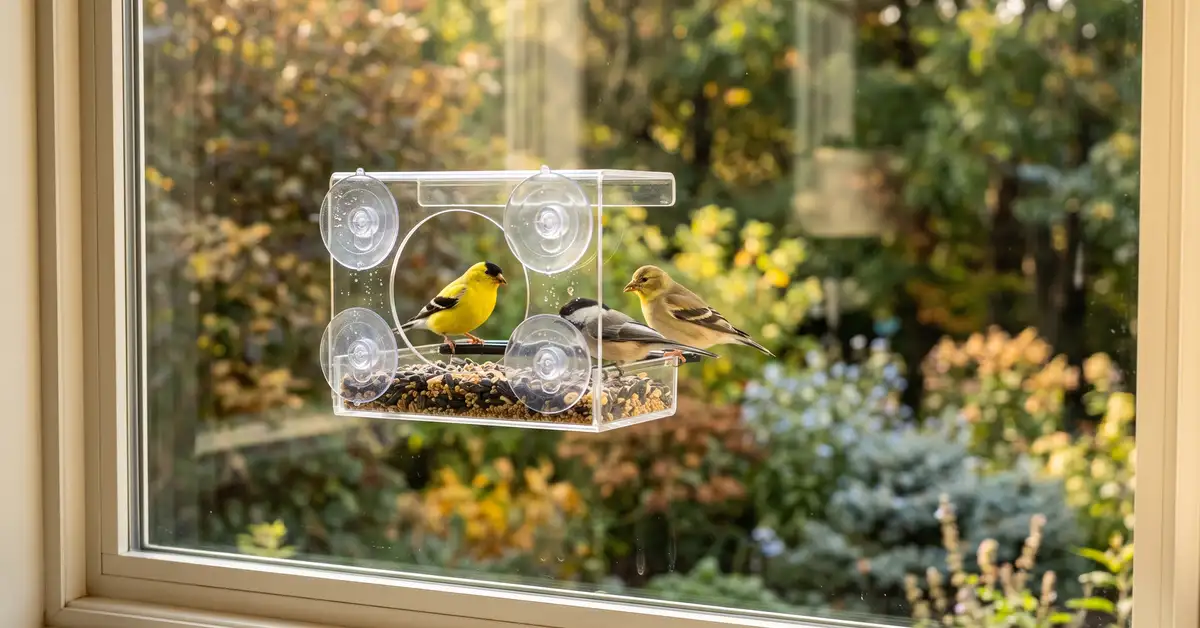
Window feeders split into two real categories: suction-cup feeders that attach to the outside of the glass, and in-window box feeders that wedge into the window opening itself, viewed from indoors. The suction category is cheaper and easier to try; the in-window box category costs more but sidesteps suction reliability altogether. Read the honest trade-off under each pick before you buy.
Transparency first: This guide contains affiliate links. If we’re enrolled in an affiliate program, we may earn a commission at no extra cost to you — it never affects how we research or rank. Read our full affiliate disclosure policy.
Nature Anywhere Transparent Acrylic Window Bird Feeder
Choose this if: you want the simplest, most affordable entry into window feeding with an easy-clean removable tray.
This is one of the more prominent suction-mounted feeders on the market: clear acrylic, a covered roof to keep seed dry, and a removable tray that slides out for refilling without taking the whole unit down. The honest trade-off is the one every suction feeder shares — in climates with real freeze-thaw cycles, temperature swings can loosen suction over time if the cups and glass aren’t kept clean and reseated, and a sill-level mount can be within reach of a determined squirrel. The maker doesn’t claim squirrel-proofing, so plan placement with that in mind.
Nature Anywhere Clear Plastic Window Bird Feeder with Gift Box
Choose this if: you want the same mechanism as the standard acrylic model but packaged as a gift.
Functionally this is the same suction-mounted, clear-viewing design as Nature Anywhere’s standard feeder, sold with retail gift packaging. It carries the same freeze-thaw suction consideration and the same lack of a squirrel-exclusion claim — buy it for the presentation, not for a different mechanism underneath.
Nature Anywhere Window Hummingbird Feeder (Large, Leak-Proof)
Choose this if: hummingbirds are the point and you want them at the glass rather than on a pole.
A suction-mounted nectar feeder built specifically for hummingbirds, marketed as leak-proof with wasp- and bee-resistant ports. The same suction caveats apply as any window mount — clean and reseat the cups through the season — and nectar feeders need a faster cleaning cadence than seed feeders regardless of mount type, since nectar ferments quickly in warm weather.
Nature Gear Window Bird Feeder with Sliding Tray
Choose this if: refill convenience matters more than anything else — the sliding tray is built to come out for filling and cleaning without disturbing the suction mount.
Acrylic construction with strong suction cups and a tray that slides for access, marketed as weather-resistant and easy to clean. The trade-off is the category-wide one: sliding trays add a moving part that can wear or stick over a season of use, and it’s still a suction mount subject to the same freeze-thaw consideration as every acrylic feeder on this list.
Nature Gear Column-Style Hanging Window Feeder
Choose this if: you want more vertical capacity than a shallow tray design without moving to an in-window box.
The column format stands taller than Nature Gear’s sliding-tray model, letting birds feed from openings along the column rather than one open tray. Exact volume isn’t itemized by the maker, so treat “more capacity than a shallow tray” as the honest, qualitative claim rather than a specific number. Same suction mount, same freeze-thaw note.
Nature’s Hangout Outside Window Bird Feeder
Choose this if: you want a lower-cost alternative to the Nature Anywhere line in the same basic suction-mounted format.
A clear suction-mounted feeder in the same general category as the Nature Anywhere and Nature Gear models above. The listing doesn’t itemize capacity or suction weight rating, so we’re not inventing numbers here — expect the same freeze-thaw and sill-access considerations that apply to every suction feeder on this list.
Songbird Essentials Clear View Deluxe Window Feeder (One-Way Mirror)
Choose this if: you want to watch birds up close without them seeing you, including for introducing kids to birding.
A 4-cup open-diner style feeder with two large suction cups and a covered roof, sold with a 14-by-8-inch one-way mirrored film that you apply to your own window glass, so birds see reflection rather than movement indoors. That film is a genuine plus for the collision-safety picture too — a reflective or patterned surface near a feeder is one of the supplementary measures both Cornell and Audubon recommend alongside placement distance. The trade-off: applying the film adds an install step beyond the feeder itself, and it changes how much you can see out that section of window.
Songbird Essentials SE539 Suet Window Feeder
Choose this if: you want woodpeckers, nuthatches and chickadees at the glass rather than sunflower-seed generalists.
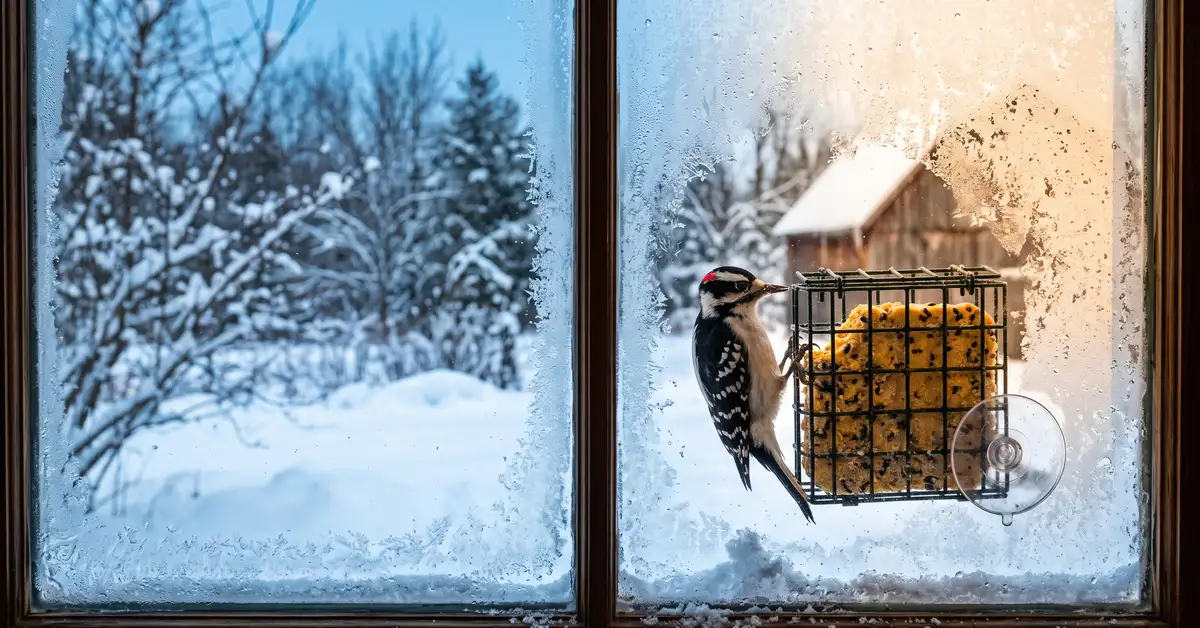
A heavy plexiglass suet cage on a cedar base with two heavy-duty suction cups and a tail prop so woodpeckers can brace the way they would on a tree trunk. It holds one suet cake at a time, so it’s a frequent-refill feeder rather than a set-and-forget one. Suet is a cold-weather food that softens and spoils above about 80°F, so this one’s a fall-through-spring feeder in most of the US unless you switch to a no-melt blend.
Coveside In-House Breadbox Window Bird Feeder (2-Way Mirror)
Choose this if: you don’t want to trust a suction mount at all — this wedges into the window frame itself.
Rather than suction cups, this mahogany feeder wedges into a double-hung window opening from 24 to 36 inches wide, held with Velcro and insulation strips, and fills and cleans from indoors without opening the window fully to the outside. It holds up to 2 quarts of seed, suet or fruit and includes a 2-way mirror panel. The trade-off is upfront cost and installation fit — it only works on windows within that width range, and it occupies part of the window opening rather than sitting on the glass.
Coveside Panoramic In-House Bird Feeder (One-Way Mirrored Panel)
Choose this if: you want the widest viewing area in the in-window category and a one-way panel rather than two-way.
Coveside’s wider Panoramic model fits 26 to 36-inch windows with the same fill-and-clean-from-indoors design as the Breadbox, but with a one-way mirrored panel instead of a 2-way mirror, so the view is one-directional rather than reciprocal. Same trade-off as the Breadbox: fixed window-width fit and higher upfront cost than a suction feeder, for a mount that isn’t subject to suction failure at all.
Woodlink WL13207 Window Glass Hanger
Choose this if: you already own a small seed or hummingbird feeder and want to try window feeding without buying a dedicated window unit.
This isn’t a feeder itself — it’s a clear plastic suction-mounted hanger rated to hold up to 4 pounds, meant for hanging a small feeder, suet cage, or hummingbird feeder directly against the glass. It’s the lowest-cost way into window feeding if you have compatible gear already, and the trade-off is the same suction consideration as any glass-mounted hardware, plus a hard 4-pound ceiling — check what you’re hanging against that limit before you buy.
What we left out, and why
| Product | Why it’s not here |
|---|---|
| Woodlink NA5546 Window Mount Hummingbird Feeder | A real product, but the listing we found didn’t give us enough independently-verified spec detail (capacity, mount hardware rating) to write an honest pick for this guide. Covered by the WL13207 hanger above if you want a Woodlink-branded route to window hummingbird feeding. |
| Songbird Essentials SEBCO312W Window Red Bird Hummingbird Feeder | Same issue: we found a listing, but without itemized capacity or mount specs we’re not padding this list with a name and no substance. Verified-or-omit applies to spec depth, not just existence. |
| Any window feeder marketed with a specific suction-weight rating we couldn’t confirm on the maker’s own page | Category-level exclusion: where a listing implied a rating but didn’t state it on a page we could independently load, we reported “not stated” above rather than inventing a number. |
Suction cups, cold weather, and the freeze-thaw question
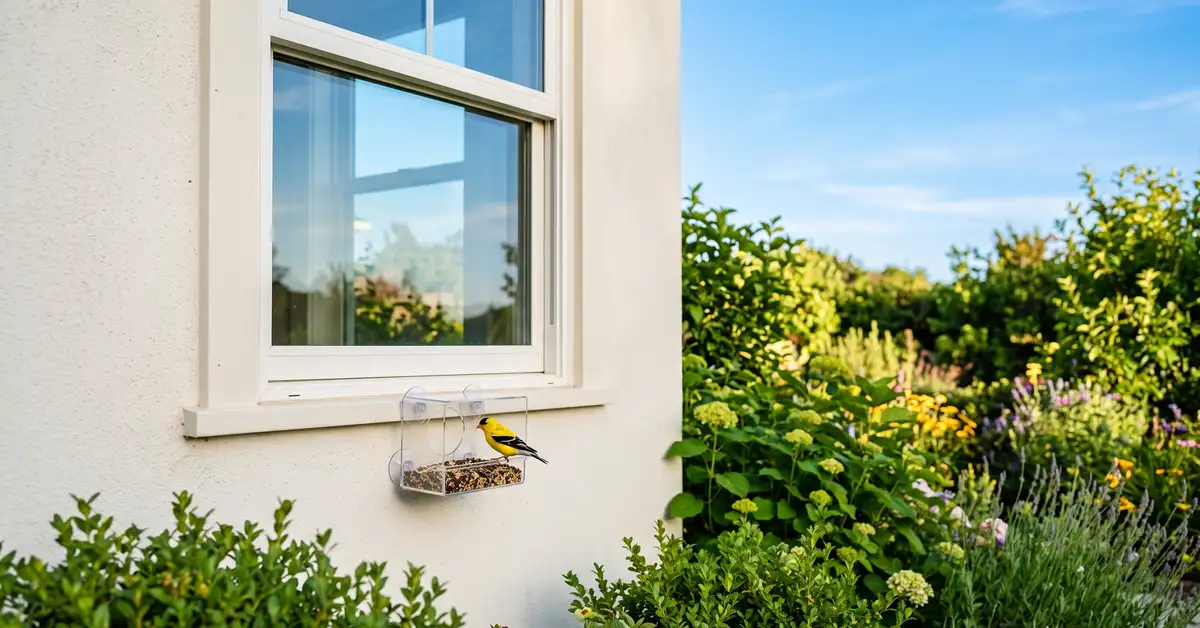
Every suction-mounted feeder on this list shares one physical reality: temperature swings make glass and plastic expand and contract at different rates, and repeated freeze-thaw cycles are the condition most likely to loosen a suction seal over a season. That’s not a defect specific to any one maker — it’s suction-cup physics. The fix is maintenance, not a different product: clean both the cup and the glass before reseating, check the seal after hard freezes or big temperature swings, and don’t mount a heavy, full feeder on a cup rated for less than its filled weight. An in-window box feeder like the Coveside models above sidesteps the question entirely by not relying on suction at all.
Squirrels, sills, and window feeders
A window feeder isn’t automatically squirrel-resistant just because it’s mounted on glass. A sill, ledge, or nearby tree branch can put a squirrel within jumping distance of a suction-mounted feeder the same way it would a hanging one. None of the makers in this roundup claim squirrel exclusion, and we’re not implying it either — if squirrel pressure is heavy in your yard, that’s a placement problem to solve (keep the window and any nearby ledges clear of easy squirrel access) rather than something a window feeder mount fixes by itself.
Hygiene and safety notes
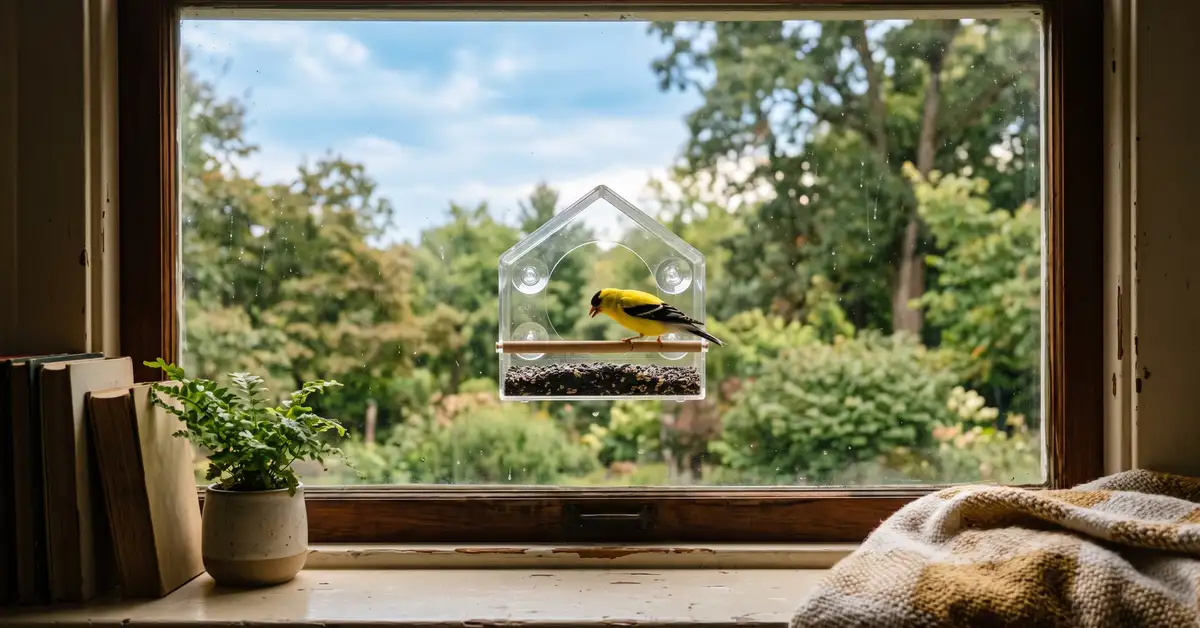
Window feeders concentrate birds at very close range, which makes cleaning cadence matter even more than it does for a pole-mounted feeder. Clean on a schedule — every two weeks is the general guidance, weekly in wet weather or heavy traffic — and if you see a visibly sick bird at a feeder, Cornell Lab’s Project FeederWatch recommends removing the feeders it is using for a couple of weeks to give birds a chance to disperse. Follow current local wildlife-agency guidance if there’s a reported disease outbreak in your area; we’re not veterinarians and we’re not claiming otherwise. We checked the CPSC’s public recall database and each maker’s own site for the products above and found no recall notices affecting these window bird feeder models or their suction/mounting hardware as of when we compiled this guide (September 2026) — that’s a search result, not a lifetime guarantee, so it’s worth a quick check yourself if you’re buying used or secondhand.
We haven’t tested any of these products ourselves — specs above come from manufacturer and Amazon listings checked live when we compiled this guide, and the placement and safety guidance comes from Cornell Lab of Ornithology and National Audubon Society research (our winter feeding guide covers the same 3/30 placement rule for pole-mounted setups, and our squirrel-proof feeder guide covers squirrel-resistant mechanisms in more depth if sill access is your bigger concern).
Window feeder questions, short answers
How we picked: manufacturer and Amazon listings for every spec, each product’s current listing checked live at the source when we compiled this guide (September 2026), plus Cornell Lab of Ornithology and National Audubon Society guidance on placement and collision safety. No testing of any kind is claimed, and we omitted rather than guessed at any product whose spec detail we couldn’t independently verify. Details in How we pick.